
Peninsula Doctor was founded in 2016 by Dr. Ian Kroes and his wife, Sabina Kroes, with a vision to deliver highly personalized, relationship-based primary care.
Over the past decade, we’ve spoken with hundreds of individuals and families exploring concierge medicine. Many share the same questions: How does concierge medicine work? What distinguishes one practice from another? Why do membership fees vary so widely? Is it worth the investment? And perhaps most importantly, what questions should patients ask to find the right physician and practice for their needs?
This guide answers those questions and offers practical advice for choosing a concierge physician in the San Francisco Bay Area.
What Is Concierge Medicine?
Concierge medicine is a model of primary care built around a close, ongoing relationship between physician and patient. Exceptional medical care begins with truly knowing the patient—not only their medical history, but also their family background, lifestyle, priorities, and long-term health goals.
This deeper understanding allows physicians to provide more personalized care, anticipate potential health concerns, and develop treatment and prevention strategies tailored to each individual.
Why Patients Choose Concierge Medicine
Patients seek concierge care for a variety of reasons. Some want an experienced physician to help navigate complex medical conditions, while others prioritize prevention, wellness, and longevity. Many value having a trusted physician who knows them well, is readily accessible when needed, and takes the time to understand their health goals. Others seek a more comprehensive, coordinated approach to care, with a physician who actively manages their health, collaborates with specialists, and helps them make informed medical decisions.
At Peninsula Doctor, we often describe concierge physicians as the quarterbacks of their patients’ healthcare. They serve as trusted medical advocates—coordinating specialists, evaluating treatment options, navigating complex decisions, and helping patients receive the right care at the right time.
Whether managing a serious diagnosis or working to prevent future illness, patients benefit from having an experienced physician who knows their history and sees the bigger picture.
The Difference: Smaller Patient Panels, More Time, and Greater Accessibility, Highest Level of Expertise in Primary Care
The defining feature of concierge medicine is a significantly smaller patient panel. Traditional primary care physicians may manage 2,000–2,500 or more patients. Concierge practices generally limit their panels to approximately 100–250 patients per physician.
At Peninsula Doctor, each physician cares for just 100 patients.
Smaller panels allow physicians to spend substantially more time with each patient—not only during appointments, but also between visits.That time is spent investigating symptoms, reviewing medical research, interpreting test results, consulting specialists, coordinating care, and developing proactive strategies to improve long-term health. Just as important is the physician’s clinical expertise.
Concierge physicians come from a variety of medical backgrounds, including Family Medicine, Internal Medicine, Pediatrics, and Geriatrics. Their education, training, diagnostic experience, and approach to patient care can vary considerably. Choosing the right physician matters as much as choosing the right practice model.
Our Approach at Peninsula Doctor
At Peninsula Doctor, we combine exceptionally small patient panels with extensive clinical experience. Each of our physicians brings more than 15 years of full-time primary care experience, including years spent at leading medical institutions diagnosing and treating a broad range of conditions.
Our approach emphasizes three priorities:
- Deep clinical expertise in primary care. Each of our physicians brings over 15 years of experience in high-volume primary care settings, managing patient panels of approximately 2,500 individuals. This extensive clinical experience translates into exceptional breadth and depth of expertise in diagnosing and treating a wide range of medical conditions, allowing us to manage many health concerns directly within our practice rather than routinely referring patients to specialists.
- Comprehensive, hands-on care. We provide in-office procedures, diagnostic testing, vaccinations, blood draws, and women’s health services, including perimenopause and menopause care.
- Proactive, data-driven prevention. We use medical history, advanced testing when appropriate, and emerging research to identify risks early and develop personalized strategies for long-term health.
With unlimited visits, exceptional physician accessibility, and comprehensive care coordination, our goal is simple: to provide thoughtful, experienced medical care throughout every stage of life.
How Much Does Concierge Medicine Cost in the Bay Area?
Annual concierge medicine memberships in the Bay Area can range from approximately $12,000 to $50,000 per person, depending on the practice, physician, and services included. Pricing models vary considerably.
Some practices charge an annual membership fee while billing separately for office visits. Others include most primary care services in the membership. Certain practices charge additional fees for house calls, after-hours visits, or specialized services. Several factors influence membership pricing.
1. Number of Patients per Physician
The smaller the patient panel, the more time and accessibility a physician can generally offer each patient. A physician caring for 100 patients operates under a very different model from one caring for 250 or 500 patients. Smaller patient panels typically require higher membership fees, as physicians care for fewer patients and can dedicate more time, attention, and personalized care to each individual.
2. Physician Experience and Expertise
Physicians with extensive clinical experience, strong diagnostic skills, and training at leading medical institutions may command higher membership fees. Years spent practicing full-time primary care in large medical settings can provide invaluable exposure to a broad range of conditions. That experience often translates into greater confidence in evaluating complex symptoms, managing multiple conditions, and determining when specialist involvement is necessary.
3. Services Included
Membership fees may cover different levels of care, including:
- Unlimited office visits and physician communication
- Comprehensive annual examinations
- Preventive and longevity-focused care
- Specialist referrals and coordination
- After-hours physician access
- House calls or care while traveling
- In office Vaccinations
- In office blood draws
- In office Respiratory testing
- Communications – text/email/EMR/video
- Hospital advocacy
- Medications
Before joining a practice, patients should understand exactly what is included and what may incur additional charges.
4. Individual, Family, and Age-Based Pricing
Some practices charge per individual, while others offer family memberships or age-based pricing. Because pricing structures vary, comparing annual membership fees alone may not provide an accurate picture of the value or services offered.
Does Insurance, Medicare, or an HSA Cover Concierge Medicine?
Concierge medicine memberships are generally paid directly by patients rather than traditional health insurance. However, some practices also bill insurance or Medicare for eligible medical services provided separately from the membership fee.
Health insurance remains important. Depending on the practice, insurance may continue to cover specialist appointments, hospitalizations, emergency care, imaging, prescriptions, and other services outside the membership.
Can You Use HSA Funds?
Eligibility to use Health Savings Account (HSA) funds depends on the structure of the membership and applicable IRS rules.Not all concierge membership fees qualify as eligible medical expenses. Patients should consult their tax advisor and HSA administrator before using HSA funds.
Are Concierge Medicine Fees Tax-Deductible?
Certain qualifying medical expenses may be deductible under federal tax rules, but concierge membership fees are not automatically deductible.Eligibility depends on the nature of the services provided, how fees are structured, and the patient’s individual tax circumstances. Patients should consult a qualified tax professional.
Is Concierge Medicine Worth It?
The answer depends on what patients value most in their healthcare.
For those seeking a physician who knows them personally, provides exceptional access, coordinates complex care, and takes a proactive approach to prevention, concierge medicine can offer substantial value.
The benefits often extend beyond the time spent in the examination room.
Having an experienced physician who can evaluate symptoms promptly, review specialist recommendations, discuss treatment alternatives, and help navigate medical decisions can make a meaningful difference—particularly when healthcare becomes complicated.
For patients who are satisfied with their existing primary care relationships, have straightforward medical needs, and prioritize minimizing out-of-pocket costs, traditional primary care may be the better choice.
The real question is not simply what concierge medicine costs, but what level of access, expertise, continuity, and personal attention matters most to you.
What Does a Concierge Doctor Actually Do?
A concierge physician provides comprehensive primary care, but with substantially more time dedicated to each patient.
An initial comprehensive examination may last up to two hours, allowing the physician to review medical history, current concerns, medications, lifestyle, family history, and long-term health goals.
Depending on the patient’s needs, the physician may recommend laboratory testing, screenings, or further evaluations.
Much of a concierge physician’s work also happens outside scheduled appointments.
This includes reviewing laboratory results, researching complex conditions, communicating with specialists, evaluating treatment options, monitoring ongoing health concerns, and following up with patients.
An important part of this role is identifying the right specialists—not simply based on reputation, but also on clinical expertise, availability, and suitability for the patient’s particular needs.
Some concierge physicians also visit hospitalized patients to provide continuity and advocacy. Hospital-based treatment remains the responsibility of the attending hospital team.
What Does Same-Day Access Mean?
Many concierge practices offer same-day appointments for urgent primary care needs and direct communication through phone, email, secure messaging, or video visits.
However, response times, after-hours coverage, and appointment availability vary across practices. Some rely on external providers to handle urgent after-hours calls, while others offer direct access to their own physicians.
Patients should ask how quickly they can expect a response, whether they communicate directly with their physician, and how urgent concerns are handled during evenings, weekends, and holidays.
What Does a Year of Concierge Membership Look Like?
No two patients use concierge medicine in exactly the same way.
Patients managing complex or acute medical conditions may communicate with their physicians frequently, sometimes daily, through office visits, phone calls, or electronic messaging.
Others may primarily focus on preventive care, including cardiovascular risk assessment, cancer screening, bone health, metabolic health, and longevity planning.
For healthy patients, the relationship may center on identifying risk factors early, tracking meaningful health data, and developing sustainable strategies to maintain health over time.
The advantage of the concierge model is its flexibility: care can be adapted to the patient’s needs rather than constrained by a fixed number of appointments.
Why Are More Doctors Choosing Concierge Medicine?
One important reason physicians transition to concierge medicine is the growing pressure of high-volume primary care.
In traditional clinics, physicians may manage panels of 2,000–2,500 patients and see approximately 20 or more patients daily, often in appointments lasting just 15–25 minutes.
Their responsibilities extend well beyond office visits. Physicians must also review test results, respond to patient messages, complete documentation, coordinate referrals, and manage increasingly complex medical needs.
These demands can contribute to burnout and leave limited time for deeper patient relationships, comprehensive follow-up, and preventive care.
Concierge medicine offers an alternative.
By caring for fewer patients, physicians can dedicate more time to clinical reasoning, complex diagnoses, patient education, care coordination, and long-term prevention.
For many physicians, this model also restores a greater sense of professional fulfillment and a more sustainable work-life balance.
What Happens When Your Doctor Switches to Concierge Medicine?
When a physician transitions from a traditional clinic to a concierge practice, they typically reduce the number of patients they care for and introduce a membership-based payment model.
Existing patients may be invited to join the new practice, but continuing care usually requires paying the membership fee.
For patients who choose to follow their physician, the experience may include longer appointments, easier communication, and more personalized care.
Those who prefer to remain in an insurance-based primary care model may need to establish care with another physician.
How Do Primary Care Models Compare
A practical overview of common differences. Services and access vary by physician and practice.
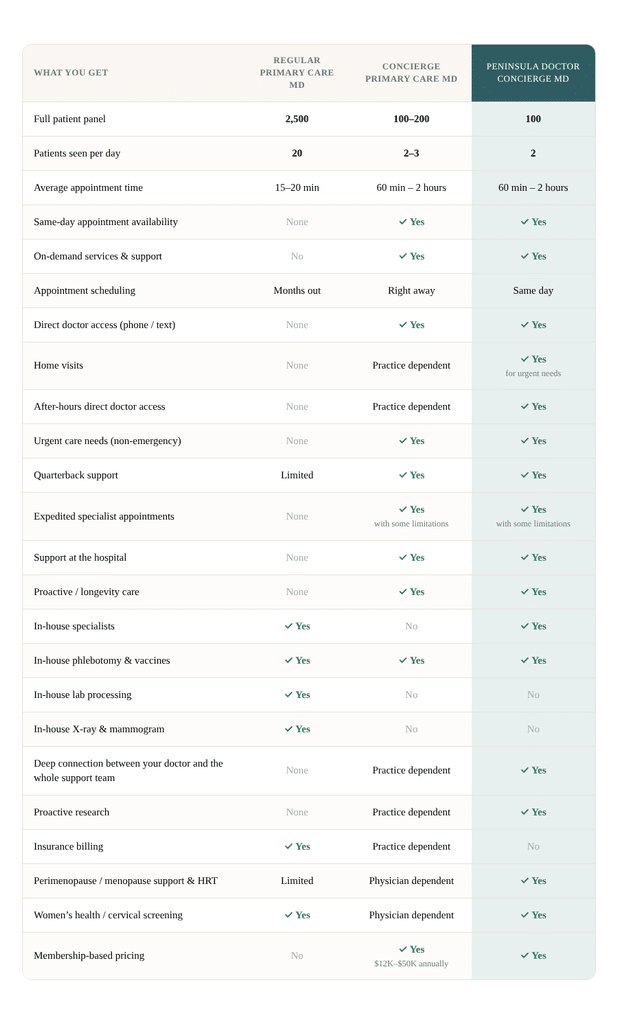
*** Note: Figures are illustrative rather than universal benchmarks. Appointment availability and clinical services depend on patient needs, physician judgment, location, and practice policies. Specialist appointment timing is determined by the receiving specialist. Confirm current membership pricing and covered services directly with each practice.
Are There Disadvantages to Concierge Medicine?
The primary limitation of concierge medicine is cost.
Membership fees can be substantial and are generally not covered by insurance. This makes the model financially inaccessible to many patients.
Smaller patient panels also mean that concierge physicians can care for fewer people, limiting the availability of this type of practice.
Additionally, the quality of care is not determined by the concierge model alone. Clinical expertise, communication, judgment, and the relationship between physician and patient remain essential.
Concierge medicine can provide greater time, continuity, and accessibility, but it does not guarantee better medical outcomes or eliminate the need for specialists and hospital-based care.
How to Choose the Right Concierge Physician in the Bay Area
Choosing a concierge physician is a personal decision. Beyond membership fees and convenience, patients should carefully evaluate the physician’s experience, clinical approach, and the services provided.
Here are important questions to ask before joining a practice.
Physician Expertise and Clinical Approach
- How many years of full-time primary care experience does the physician have?
- What is the physician’s background in diagnosing and managing complex medical conditions?
- Does the physician generally evaluate and treat conditions in-house before referring to specialists?
- What in-office procedures and diagnostic services are available?
Accessibility and Communication
- How many patients does each physician care for?
- How can patients communicate with their physician—phone, email, text, secure messaging, or video?
- What are the typical response times for routine and urgent concerns?
- Are same-day appointments available?
- What coverage is provided after hours, on weekends, and during physician vacations?
Specialists and Hospital Care
- Does the practice maintain strong relationships with specialists at leading Bay Area medical institutions?
- How does the physician help select specialists and coordinate treatment?
- Does the physician have hospital privileges or provide support during hospitalization?
- Can the practice coordinate care with specialists outside the Bay Area?
Comprehensive Services
- Does the practice offer blood draws, vaccinations, diagnostic testing, and minor procedures?
- Are women’s health services available, including cervical screening, IUD placement, and menopause treatment?
- Does the practice provide preventive and longevity-focused care?
- Are house calls available, and do they involve additional fees?
- What medical support is available when patients travel?
Practice Structure and Continuity
- How long have the physicians and medical support staff been with the practice?
- Can the physician coordinate with family members or caregivers when authorized by the patient?
- What services are included in the membership, and which cost extra?
- What happens if the physician leaves the practice or the patient wishes to change physicians?
Final Thoughts: Finding the Right Concierge Practice
Concierge medicine is about more than longer appointments or faster access. At its best, it is about building a lasting relationship with an experienced physician who understands you as a whole person and takes an active role in your long-term health. Equally important is the personal connection between patient and physician. Trust, mutual respect, and open communication form the foundation of exceptional medical care.
The most important factors are the physician’s clinical expertise, the quality of the relationship, the practice’s ability to deliver comprehensive care, and the level of accessibility and coordination patients can expect.
At Peninsula Doctor, we believe exceptional primary care combines deep medical experience with time, trust, and personal attention.
Ultimately, the right concierge practice is one where you feel confident that your physician truly knows you, understands your priorities, and will be there to guide you when it matters most.
Take the time to meet the physicians you are considering and, whenever possible, the practice’s founder. Learn about their philosophy of care, what matters most to them, and how their approach aligns with your own expectations and health priorities. The right personal connection is just as important as clinical expertise.