
As a patient of ours at Peninsula Doctor, you may have had your lipoprotein(a) tested already. Lp(a) is a cholesterol-carrying particle and close cousin of the bad cholesterol (LDL) and Apolipoprotein B, but wrapped in an extra “sticky” protein. That extra protein makes Lp(a) especially good at three things: building plaque in the arteries, increasing inflammation, and encouraging blood clots. This is why the American College of Cardiology and American Heart Association 2026 dyslipidemia guidelines now recommend that every adult have Lp(a) checked at least once.
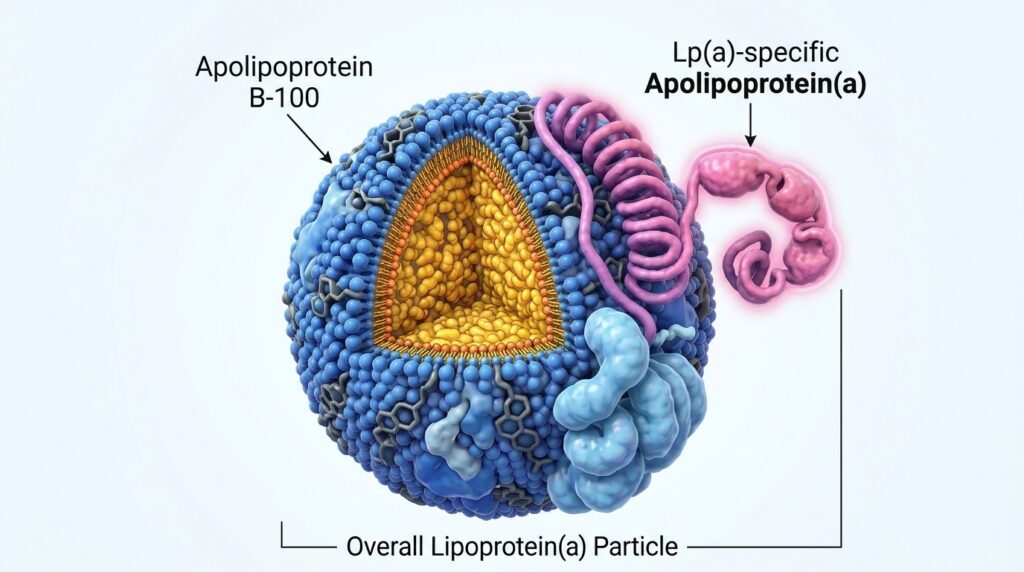
How Lp(a) is different from LDL and Apo B
- Your Lp(a) level is set by your genes and thought to stay fairly steady over your lifetime. For this reason, with the exception of postmenopausal women, repeated measurements were not routinely thought to be necessary (though recent real-world data suggests there is more individual variability in the same person then we once believed).
- Diet, exercise, and statins don’t affect it much. This is the frustrating part, as the healthy habits that lower LDL/Apo B do not meaningfully lower Lp(a).
- About 1 in 5 people worldwide carries a high level. The probability is even higher in those of South Asian and African descent.
- It is associated with an increased risk of cardiovascular disease. Higher Lp(a) is linked to more heart attacks, strokes, blocked leg arteries, and a stiff, narrowed aortic heart valve, and the higher the number, the higher the risk.
Some of you have a high Lp(a), and we’ve told you that we didn’t yet have a medicine proven to lower it substantially. We have known that PCSK9 inhibitors, like evolocumab (Repatha) and alirocumab (Praluent), reduce Lp(a) by roughly 20-30%, but we do not know if those modest reductions make a meaningful difference aside from its LDL-lowering effect. We may have told you that a few medicines were in the research pipeline, and we were eagerly waiting for those findings. Well, the first big trial results have arrived and the initial results were not what we were hoping for. While the future of Lp(a) lowering medicines remain uncertain, these results are only preliminary and we do not have the full picture yet.
A Long-Awaited Trial and a Disappointment
Pelacarsen, developed by Novartis and Ionis Pharmaceuticals, is an injectable drug called an antisense oligonucleotide, engineered to work like a genetic “off switch” and telling the liver to make less Lp(a). In earlier studies, it lowered Lp(a) by about 70–80%. The big outcome trial was called Lp(a) HORIZON, which included a little over 8,300 patients at hundreds of medical centers worldwide. All had established heart disease (a prior heart attack, stroke, or serious peripheral artery disease) and high Lp(a). Half got monthly pelacarsen injections; half got a placebo injection, and patients were followed for about 4-5 years.
As of this month (September 2026), the companies announced the top-line results from their Phase 3 trial: Pelacarsen lowered Lp(a) as expected, but did not significantly reduce major cardiovascular events (heart attacks or strokes). I remember the disappointment I felt when I first saw the New York Times headline circulating widely: “Another Heart Drug Fails, Shocking Cardiologists.” If you ask any cardiologist, they will say this felt like a huge blow for a long-awaited therapeutic.
Why This Doesn’t Tell the Whole Story
All that said, here is why a disappointing headline is not the end of the story. A few points that need to be made about these findings, about what it does not mean as much as what it might imply.
In this particular trial, everyone was also on excellent standard heart medications already. In other words, their “bad” LDL cholesterol was pushed down to an average of about 66 mg/dL, which is well-controlled compared to most. These patients were already on aggressive treatment, so when the risk is already lowered this far, it becomes harder for any additional drug to show a further benefit. On top of excellent heart care, such as lowering LDL and Apo B to very low levels, the additional benefit of lowering Lp(a) may have been too small of an effect to see.
Secondly, it may have been a little too late. Lp(a) damages arteries slowly, over an entire lifetime. Treating older patients who already have decades of built-up disease for only a few years may not be enough to improve outcomes. Lowering Lp(a) earlier in life might matter more.
What Comes Next
These results do NOT mean that Lp(a) is harmless, nor that this is the end of the story on Lp(a)-lowering agents.
The genetic evidence that high Lp(a) causes heart disease remains very strong. As mentioned, it is plausible that the drop in Lp(a) may not have been soon enough, deep enough, or long enough. Genetic studies suggest Lp(a) may need to fall by a large absolute amount to change outcomes. A 70-80% drop sounds huge, but the actual reduction may fall short of what’s needed. Additionally, the detailed data on the Lp(a) HORIZON trial isn’t public yet. The headline only says whether the whole group benefited. The full results, including subgroup analysis, such as whether or not patients with the very highest Lp(a) levels benefited, will be presented at the American Heart Association meeting in November 2026.
Newer investigational drugs called small interfering RNA therapies (siRNA) – e.g. Olpasiran by Amgen, Lepodisiran by Eli Lilly, and Zerlasiran by Silence Therapeutics all lower Lp(a) by more than 90%. Whether a more powerful drop of over 90% would work is still unknown, as these drugs are still in Phase 3. The good news is that both Lepodisiran’s ACCLAIM-Lp(a) trial and Olpasiran’s OCEAN(a)-PreEvent trial have clinical arms that intentionally include people before they experience a major cardiovascular event (known as primary prevention), so this may give us interesting data. There is more to come.
The Bottom Line
If you have not had your Lp(a) checked, please reach out to us for this to be done at least once. If your Lp(a) is high, the most important step for now is to aggressively control your other risk factors: LDL cholesterol and Apo B, blood pressure, blood sugar, not smoking, and weight control. This is still an active, fast-moving area of research, and more answers are coming. We’ll be sure to keep you updated as we hear more.
If you have questions about your Lp(a) results or would like help understanding what they mean for your health, please reach out to our team. We’re here to help you understand your results and determine the appropriate next steps for your care.
This article was written by Dr. Judy Kim.
Please note: This article is for informational and educational purposes only, and is not intended to be medical advice. It does not constitute an endorsement or recommendation of any peptide treatment. As always, please discuss any treatments you are considering with your physician.